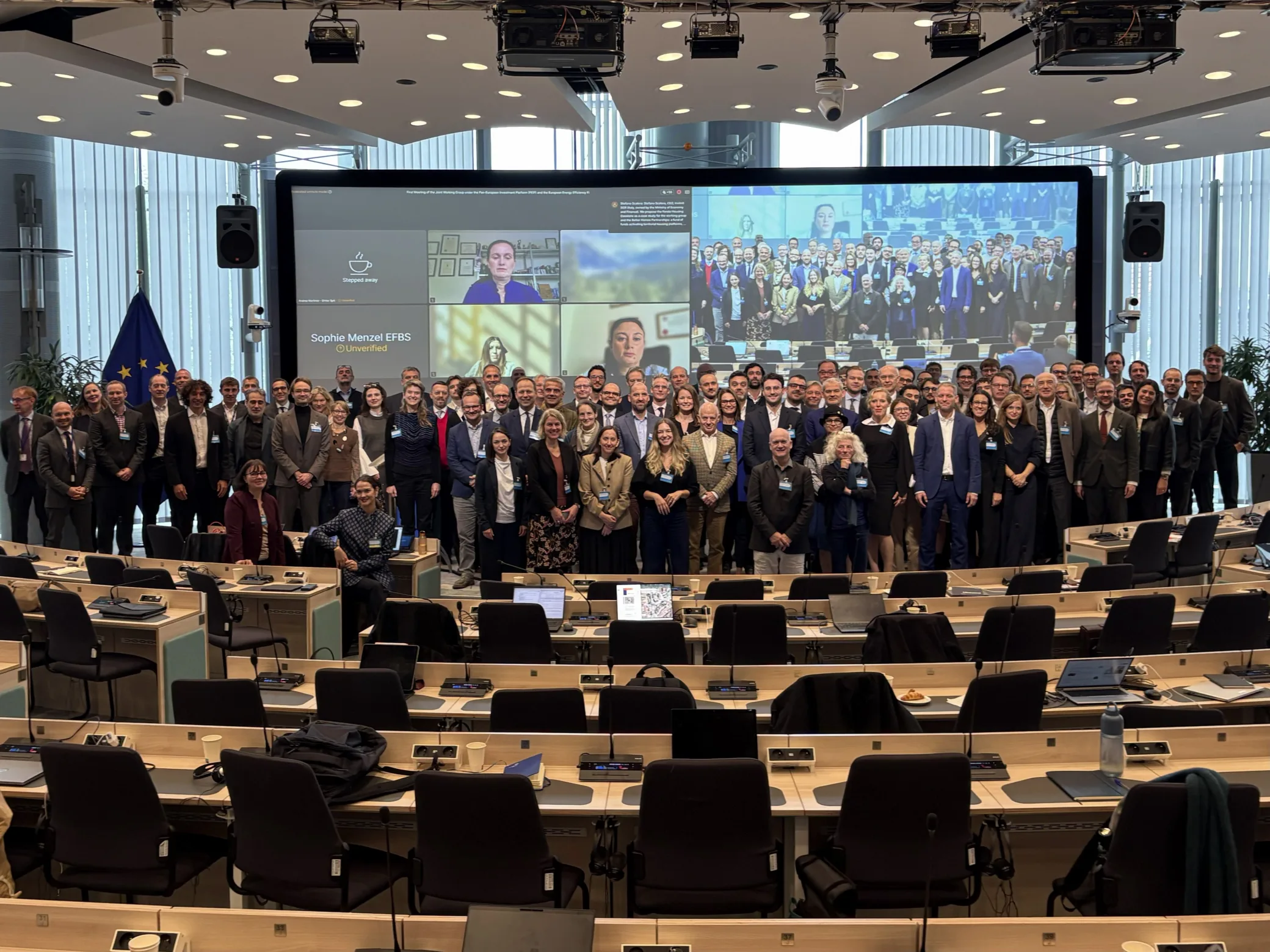
Efficient Buildings Europe at Commissioner Jørgensen's roundtable on the Housing Simplification Package
On 14 October, Commissioner Dan Jørgensen brought together representatives of the construction industry, cities, social housing providers, development banks, architects, building owners, tenants and engineers to discuss the upcoming Housing Simplification Package. Our Secretary General, Rémi Collombet, represented Efficient Buildings Europe and shared three key messages.
First, preserve regulatory certainty. The revised Energy Performance of Buildings Directive (EPBD) is only now being implemented. Reopening it prematurely would create uncertainty for manufacturers, investors, housing providers and households. Delivery will help the EU meet its affordability objective.
Second, remove the practical barriers to renovation. Lengthy permitting procedures, fragmented administrative requirements, complex decision-making in co-owned buildings and split incentives between landlords and tenants continue to hold back renovation projects. These are well-known obstacles that deserve concrete solutions.
Third, unlock financing at scale. With the Recovery and Resilience Facility ending and national budgets under pressure, mobilising private finance must become a priority. Public funding should be used strategically to de-risk investments and attract private capital, while protecting vulnerable households. This is why we support the creation of an EU renovation loan facility.
Takeaways from the discussion
- There was broad agreement on the need to focus on implementing the existing EU framework, including the EPBD, RED and ETS2. Partial or inconsistent implementation risks fragmenting the Single Market rather than creating the predictability needed for investment.
- The real cost barriers go well beyond sustainability requirements. Construction costs, the cost of capital, lengthy permitting and reporting obligations were repeatedly highlighted. As BPIE pointed out, the sustainability premium represents less than 5% of project costs.
- Financing rules need attention. Participants raised proposals to exclude affordable and sustainable housing investments from public debt calculations and lower capital requirements to stimulate lending. The fact that VAT can sometimes be higher for renovation than for new construction also deserves attention.
- Innovation can help deliver more homes, faster. Digitalisation, offsite and modular construction, industrialised renovation, vertical extensions and the conversion of existing buildings all offer opportunities to reduce costs, accelerate delivery and make better use of our existing building stock.
Europe needs to simplify the delivery of affordable, sustainable housing, not roll back the policies that make buildings more efficient and affordable to live in. The priority now should be to turn the existing framework into investment and projects on the ground.
Read our response to the call for evidence on the Housing Simplification Package.